2 October 2026
Set up a Fintech Company in Switzerland
Our company registration agents offer assistance in opening a Swiss fintech company. We will help you obtain a fintech license in Switzerland.

If you want to open a fintech company in Switzerland, you must go through several procedures, among which the licensing one is quite important.
| Quick Facts | |
|---|---|
| Availability of specific legislation (YES/NO) | Yes, the fintech licence under Art. 1b of the Banking Act (since 2019) and the DLT Act (in force 2021). |
Availability of special fintech licenses in Switzerland (YES/NO) | Yes, specific licenses can be obtained. |
Mandatory company registration for carrying out fintech activities (YES/NO) | Yes, the Swiss private limited liability company and public company can be used. |
| Activities to complete based on a fintech license | – e-payments, – cryptocurrency issuance and trading, – crypto exchanges, – investment funds management dealing with crypto assets, – initial coin offerings (ICOs). |
| Licensing exceptions (YES/NO) | Yes, there are also exceptions. |
| Local address requirement (YES/NO) | Yes, no matter the activities to complete, the company must have a Swiss address to be issued the license. |
| Licensing authority | The Financial Markets Supervisory Authority (FINMA). |
| Anti-money laundering regulations applicability (YES/NO) | Companies must verify if they are required to these regulations. |
| Authorization requirements | The fintech licence is required for companies that commercially accept public deposits (fiat or crypto) of up to CHF 100 million without investing them or paying interest on them. |
| Share capital requirement (YES/NO) | At least 3% of the deposits the company accepts (at least CHF 300,000). |
| Minimum number of clients requirement to obtain a Swiss fintech license (if any) | No minimum number of clients. |
| Maximum amount that can be accepted as a deposit from all clients (if any) | CHF 100 million under the fintech licence (CHF 1 million under the licence-exempt sandbox). |
| Taxation of fintech companies in Switzerland | Fintech businesses are subject to the same tax rules as other companies. |
| Special programs availability (YES/NO) | Yes, the SandBox Regime, which is a tool through which fintech companies can test the market before launch. |
| Support in setting up a fintech business in Switzerland (YES/NO) | Yes, you can rely on our Swiss company formation agents for assistance. |
Is full foreign ownership available in a Swiss fintech business?
Yes, there are no restrictions applicable to foreign investors who want to open companies in Switzerland in the fintech sector.
What are the steps to open a fintech company in Switzerland?
The following:
- trading name reservation;
- Articles of Association and other information preparation;
- Swiss legal address contracting (we offer virtual office services for prices that start at CHF 390 per month);
- bank account opening;
- cantonal Trade Register incorporation;
- licensing.
What is the recommended legal form for a Swiss fintech company?
You have two options:
- the private limited liability company;
- the joint stock corporation – one of the two most used business forms in Switzerland.
What is the minimum capital to open a fintech company in Switzerland?
The minimum amount imposed by the Financial Market Supervisory Authority (FINMA) is CHF 300,000.
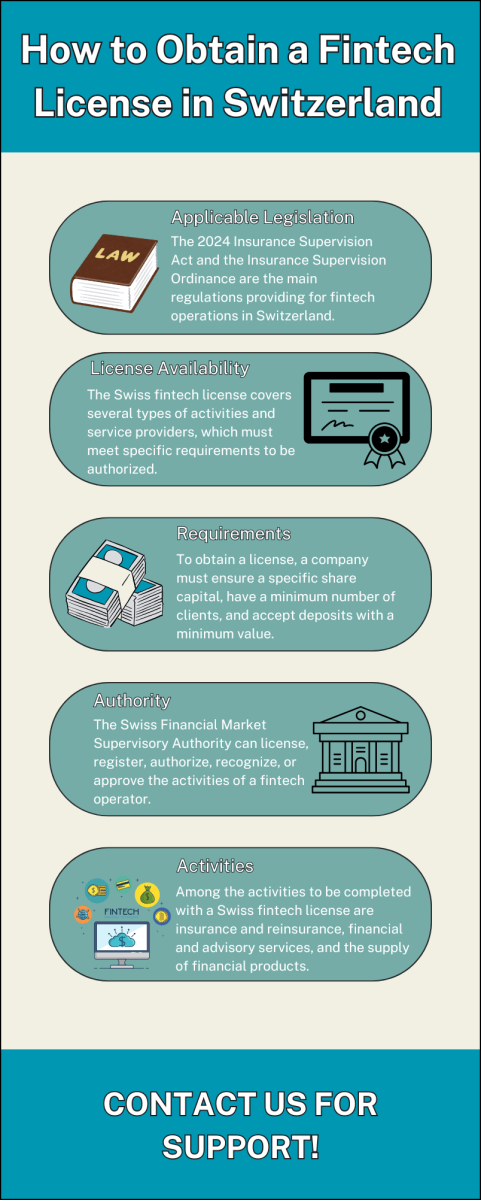
You can read about this subject in the infographic below:
What are the types of fintech licenses I can apply for in Switzerland?
The following:
- the light banking license;
- the securities firm license;
- the DLT trading facility license;
- the broker license.
What are the licensing procedures available for fintech companies in Switzerland?
The Financial Market Supervisory Authority provided 5 types of authorization procedures for those seeking to apply for fintech licenses in Switzerland. Specifically:
- licensing, which implies going through the document preparation, filing, and verification stages with FINMA when engaging in various financial activities;
- registration, which applies to insurance intermediaries that also operate in the fintech field;
- recognition which applies to self-regulatory organizations (SROs), as many fintech businesses must appoint such a body;
- authorization which applies to Swiss financial services providers that offer client advice solutions, for example;
- approval, which refers to the products supplied by fintech operators and which must be verified by FINMA before being released on the market.
Are there any special requirements to comply with when applying for a fintech license in Switzerland?
The application for a fintech license is submitted to the Financial Market Supervisory Authority and must contain the following documents:
- a description of the reasons for opening the Swiss fintech company;
- detailed information about the activity, structure of the company, clients’ address, and place (region or even countries of offering its services);
- an extract from the Swiss Trade Register indicating the incorporation of the company in this country;
- proof of having business premises in Switzerland;
- information about the personnel;
- drafting a business plan;
- submitting the financial statements for the past 3 years, where these are available;
- appointing an auditor for the company;
- drafting specific IT and cybersecurity documentation;
- creating Anti-Money Laundering documentation;
- appointing directors who have experience in the financial sector (fit and proper tests are conducted by FINMA in this sense).
IMPORTANT! At least one Swiss resident director must be appointed in a fintech company.
The following video offers a short presentation on the Swiss fintech companies:
How long does it take to obtain a fintech license in Switzerland?
The procedure can take 6 to 12 months, depending on the type of license requested.
What activities can a Swiss fintech company undertake?
Here are some of the activities that can be completed with a fintech license are those related to:
- e-payments;
- cryptocurrency issuance and trading;
- crypto exchanges;
- investment funds management dealing with crypto assets;
- initial coin offerings(ICOs).
How are Swiss fintech companies taxed?
Such companies will pay federal, cantonal, and municipal taxes based on their registered addresses. However, in certain cantons, startups and even investors benefit from tax incentives and exemptions.
Also, our accountants in Switzerland are at your disposal with accounting services for your fintech company.
Investors are invited to contact our team of consultants in company formation in Switzerland for support in applying for a fintech license.