3 August 2026
Open a Trust in Switzerland
Our team of specialists in company formation in Switzerland can assist with advice on how to register a Swiss trust.
The concept of administering various financial assets through a trust is still not available under Swiss substantive law. The country did not have a basic rule of law that defined the idea of trust, as the country’s national legislation does not follow the Anglo-Saxon legal framework, which has a long tradition of regulating the concept of trust.
This is caused by the fact that Switzerland follows the Roman legislation, which does not include regulations on the foundation of a trust and it is important to know that the Swiss Civil Code does not include provisions on this concept.
However, Switzerland has made relevant progress and ratified in its national law the Hague Convention, through which foreign trusts are recognized in this country; our team of consultants in company registration in Switzerland can offer an in-depth presentation on the provisions of the Swiss law.
What is the purpose of a trust in Switzerland?
The trust is a type of structure that can be used for the administration of the wealth of various entities. Commonly, the trust is opened with the purpose of planning and administering the wealth of affluent families or of persons who have a high net worth value.
| Quick Facts | |
|---|---|
| Availability of Trust Law (YES/NO) | No, however, Switzerland is a signatory member of the Hague Convention. |
Possibility to create a Swiss trust (YES/NO) | No – the Federal Council abandoned the draft Swiss trust law in September 2023 and Parliament wrote off the motion in February 2024. |
Recognition of foreign trusts (YES/NO) | Yes, foreign trusts are recognized in Switzerland. |
| Types of trusts recognized in Switzerland | – fixed, – discretionary, – revocable and irrevocable trusts. |
| Possibility to have Swiss assets held in a trust (YES/NO) | Yes. |
| Trustee services availability (YES/NO) | Yes, trustee services are available in Switzerland. |
| Rules applicable to trustees | The 2020 Trustee Regulations. |
| Admission requirements for trustees (YES/NO) | Yes, trustees must registered with the Financial Market Supervisory Authority. |
| Professional association of trust companies (if applicable) | The Association of Swiss Trust Companies (SATC). |
| Regulatory requirements for Swiss trustees (YES/NO) | Trust management companies must have a management board of at least 2 members and a minimum share capital of CHF 100,000. |
| Taxation of trusts in Switzerland | Trusts are not taxpayers in Switzerland; trust assets and income are taxed in the hands of the settlor or the beneficiaries, depending on the type of trust. |
| Possibility to create international trusts by Swiss citizens (YES/NO) | Yes. |
| Advantages of trust recognition in Switzerland | – recognition is made in accordance with international treaties, – no taxes imposed on the trust itself, – access to specialized trustee services. |
| Requirements to comply with international laws (if any) | Yes, with Anti-Money Laundering Regulations. |
| Services for trusts in Switzerland | We are at the service of those who want to have their foreign trusts recognized in Switzerland. |
In order to protect the interests of the family members, the trust is used as a way through which a trustee (the person who administers the trust) can develop various strategies for the preservation of the respective assets or even increase their value. Our team of specialists in company registration in Switzerland can advise on the basic characteristics of a trust, which are presented below:
- the trustee must act in the best interest of the persons who are the beneficiaries of the trust;
- the trust is set up between a settlor, a trustee and the beneficiary (or beneficiaries);
- the settlor is the person who requests the foundation of a trust;
- the trustee can be a natural person or a legal entity acting in the name of the beneficiary;
- however, the manner in which the trustee handles the assets is done as requested by the settlor.
A trust is generally employed for managing the real estate properties of wealthy families or other types of assets, and it is especially designed with the purpose of creating asset protection strategies. Under this structure, the assets of wealthy persons are transferred into the possession of the trustee, but only with the purpose of administering the respective assets. It is necessary to know that under the Swiss legislation, the trust is not seen as a legal entity.
Types of trusts recognized in Switzerland
According to international laws, there are several types of trusts that can be created in most countries. In Switzerland, they are recognized based on taxation. The Swiss law divides them into:
- transparent trusts for tax purposes;
- opaque or non-transparent trusts from a taxation point of view.
From a taxation perspective, trusts in Switzerland are categorized as:
- revocable trusts;
- irrevocable trusts.
If you need more information on the taxation of such entities, you can obtain specialized information from our accounting company in Switzerland.
Revocable trusts in Switzerland
Revocable trusts are recognized in Switzerland, and they are defined as entities in which the settlor has control over the assets of the trust. As such, the settlor will pay taxes on the assets and income generated by the trust. If the settlor is a Swiss citizen or resident, he or she will be liable for the following levies:
- personal income tax;
- wealth tax.
Also, the distribution of income or assets from a revocable trust to the beneficiaries will also attract a gift tax imposed at a cantonal level. From this point of view, it is important to note that the levy depends on the relationship between the settlor and beneficiaries and the canton in which the settlor resides.
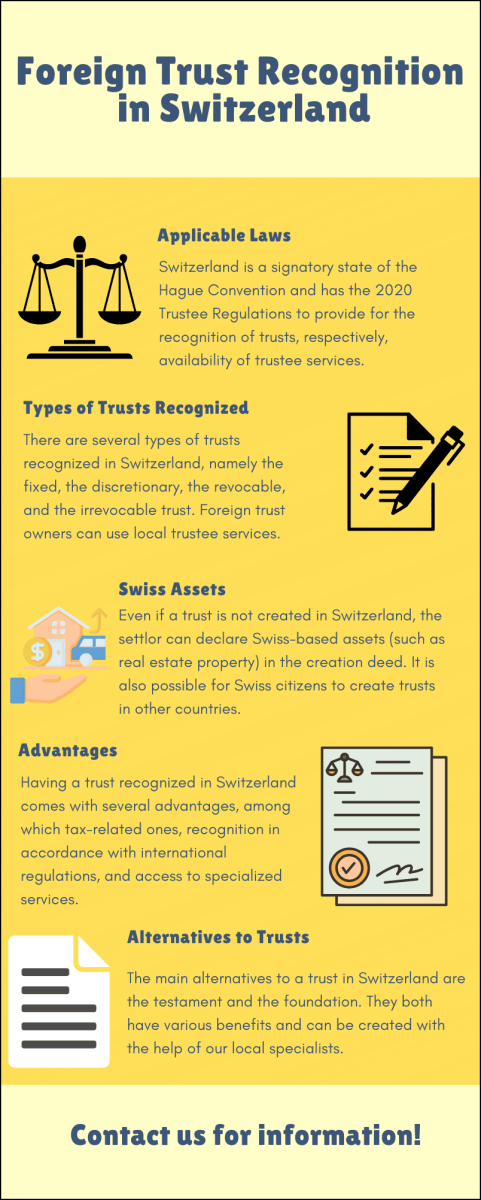
If you need more information on the recognition of revocable trusts, you can rely on our Swiss company formation agents who can offer details. Here is also an infographic on this subject:
Irrevocable trusts in Switzerland
When it comes to irrevocable trusts, they are divided into:
- fixed interest trusts;
- discretionary trusts.
In the case of fixed interest trusts, the settlor will enable a trustee or fiduciary to administer the assets. As such, the assets and income generated by the entity will fall upon the beneficiaries from a taxation point of view. They will pay the income tax in accordance with the portion of the assets they own.
In the case of the discretionary trust, taxation will occur only if the beneficiary or beneficiaries are Swiss citizens or residents.
If you want to create a trust and have it recognized in Switzerland, our local representatives can help you. We are also at your disposal if you want to open a Swiss company in the canton you desire.
What should one know on Swiss trustees?
As presented earlier, a trust is recognized in Switzerland as long as it is registered under the legislation of a foreign jurisdiction. Provided that the settlor will appoint a Swiss trustee, this alone does not make the trust taxable in Switzerland (income is attributed to the settlor or beneficiaries). Persons who are considering opening a trust in Switzerland should know that professional trustees must be licensed by FINMA (since the Financial Institutions Act of 2020).
However, the activities of trusts that operate in this country are supervised by the Swiss Association of Trust Companies (SATC), which was created with the purpose of establishing the minimum standards that have to be met by those operating a local trust. In addition to the FINMA licence, they must follow the recommendations that were created by the SATC in 2012, prescribed under a “White Paper”.
Here is also a video on this subject:

What is the data on wealth management in Switzerland?
Switzerland is known at a global level for its financial services sector; it is also the leading jurisdiction on wealth management services, especially for international assets. Foreigners choose Switzerland to have their assets managed here due to the financial stability of the local market. Our team of specialists in setting up companies in Switzerland can advise on the wealth management options investors have, and it is important to know that this industry is characterized by the following:
- the assets held under management are expected to reach a value of USD 5.712 billion by the end of 2024;
- the financial advisory services market is also projected to reach a market volume of USD 5.703 billion by the end of 2024;
- for the near future, the wealth management market is predicted to register an annual growth rate of 1.15% by 2028 and get to a market volume of USD 5.98 billion in terms of assets under management.
Persons interested in more details on other regulations related to the management of assets in Switzerland and the manner in which a trust can be recognized under the local legislation can address to our team of Swiss company formation specialists for personalized assistance on this matter.